

The most common semaglutide side effects are gastrointestinal, and they usually show up while your dose is being increased, not after you have settled onto a steady maintenance dose. Most people find nausea, mild vomiting, and changes in bowel habits ease within a few weeks. A small number of reactions are serious enough that you need to stop and seek help immediately.
Expect one or more of these, especially in the first few months:
- Nausea, vomiting, diarrhoea, or constipation
- Abdominal discomfort, headache, fatigue, or indigestion (dyspepsia)
Treat these as red flags requiring urgent medical attention: severe abdominal pain that spreads to your back (possible pancreatitis), swelling of the face or throat with difficulty breathing (anaphylaxis), yellowing of the skin or eyes (jaundice), a marked drop in how much you're urinating, or sudden vision changes.
If you develop any red flag symptom, stop the injection or tablet and get medical attention straight away. For everything else, milder nausea or irregular bowel habits, contact your prescriber about slowing your dose increase before you consider stopping altogether.
Pro Tip: Keep a note on your phone of the date you started each new dose. If nausea appears within days of a step up, that timing alone tells your prescriber almost everything they need to know to adjust your plan.
Key Takeaways
Semaglutide's side effects are overwhelmingly gastrointestinal, cluster around dose increases, and are manageable in most patients through slower titration and proactive hydration.
| Point | Details |
|---|---|
| GI side effects are common | Trial data shows GI reactions in up to 36.4% of semaglutide patients and 73% of Wegovy patients, versus 15% to 47% on placebo. |
| Dose escalation is the danger window | Most nausea, vomiting, and bowel changes start during dose increases and settle once you reach a stable dose. |
| Serious events need urgent care | Severe abdominal pain, jaundice, reduced urination, or allergic swelling all require immediate medical attention. |
| Source licensed products only | Avoid compounded semaglutide; use regulated prefilled pens to prevent dosing errors and severe toxicity. |
| Get clinical input early | Novagp offers same-day online GP reviews for dose advice, medication interactions, and weight-loss follow-up prescriptions. |
Table of Contents
- How common are semaglutide side effects, and when do they start?
- What do the common side effects actually feel like?
- Can semaglutide cause injection-site reactions or allergic responses?
- What are the serious but uncommon risks of semaglutide?
- Who should avoid semaglutide or take extra precautions?
- How are semaglutide side effects managed day to day?
- What happens long term, and after stopping semaglutide?
- What do prescribing information and safety advisories warn about?
- Are there special precautions for pregnancy, older adults, or children?
- How is semaglutide monitored, and how do you report side effects?
- Getting support if semaglutide side effects worry you
- Frequently asked questions
- Sources
How common are semaglutide side effects, and when do they start?
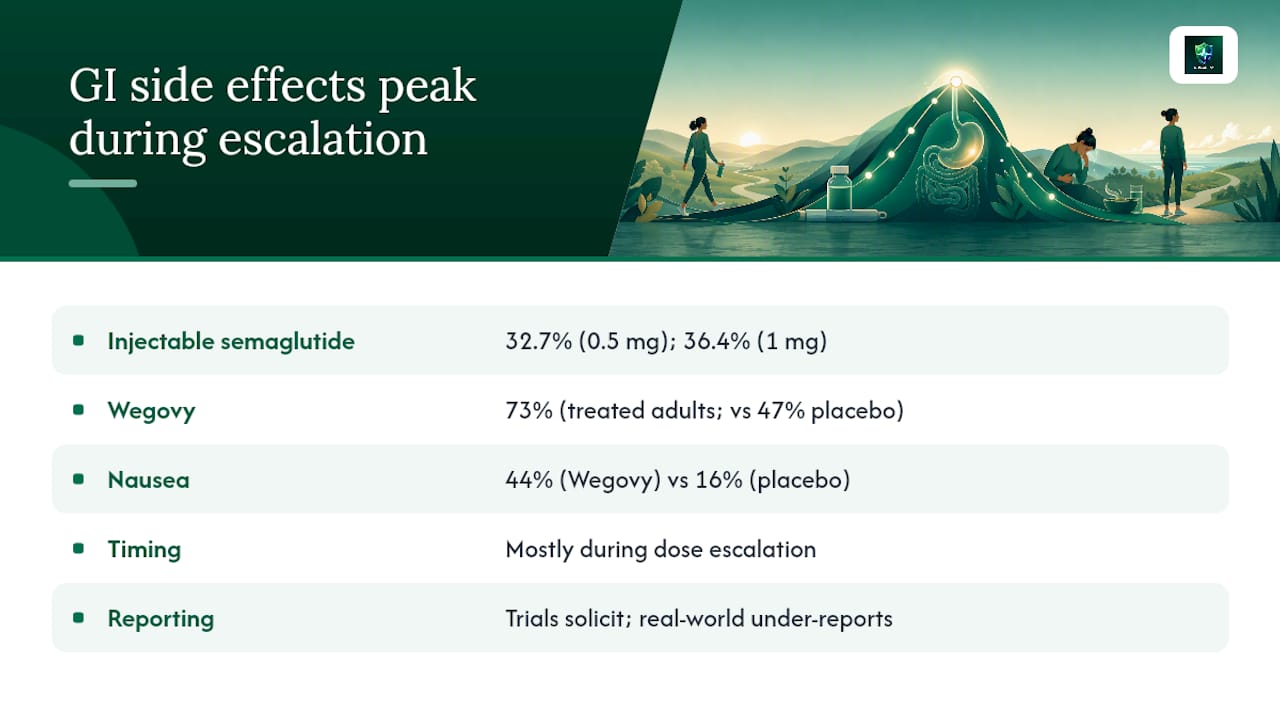
Gastrointestinal reactions are the dominant safety signal across every semaglutide product, and the trial data is specific about how often they occur. In placebo controlled trials of injectable semaglutide, gastrointestinal adverse reactions were reported in 32.7% of patients on the 0.5 mg dose and 36.4% on the 1 mg dose, compared with 15.3% on placebo. For Wegovy, used specifically for weight management, the rate climbs further: 73% of treated adults reported gastrointestinal adverse reactions versus 47% on placebo, with nausea affecting 44% of Wegovy patients against 16% on placebo.
In numbers: Nearly three in four adults on Wegovy report some gastrointestinal side effect during treatment, but the FDA's own prescribing data shows most of these cluster around dose increases rather than persisting at a flat rate throughout treatment.
The timing pattern matters more than the raw percentage. Most GI adverse reactions occur during the dose escalation phase rather than once you've reached your target maintenance dose. That's a meaningful distinction if you're trying to decide whether a bad week is a sign to quit or simply a sign your body is adjusting to a new dose level.
For most people, symptoms are mild and transient. A minority discontinue treatment altogether because gastrointestinal reactions become intolerable rather than merely uncomfortable, and that risk rises with faster dose increases or skipped titration steps. It's also worth knowing that these figures come from controlled trial settings, where every symptom is actively solicited and recorded. In everyday clinical use, milder side effects are frequently under-reported, partly because patients assume nausea is simply "part of the deal" and don't mention it unless it becomes severe. That gap between trial data and real-world reporting is one reason ongoing contact with a prescriber, rather than a one-off consultation, tends to produce a smoother experience.
What do the common side effects actually feel like?
Nausea is the symptom most people describe first, and it's rarely subtle. It tends to arrive as a persistent queasiness rather than sudden sickness, often worse after eating anything rich or heavy. Vomiting is less common than nausea alone but can follow if a meal is too large or too fatty for where your gut currently sits. Diarrhoea and constipation can alternate in the same person over different weeks, which understandably confuses people expecting one consistent pattern. Abdominal pain tends to present as bloating or cramping rather than a sharp, localised pain, and dyspepsia (indigestion, or a burning sensation after eating) is common alongside it.

The mechanism behind all of this is straightforward once explained properly. Semaglutide mimics a natural gut hormone called GLP-1, which slows gastric emptying and increases feelings of fullness. That's precisely why it works for appetite control and blood glucose management, but it's also exactly why your stomach reacts. Food sits in your stomach for longer than it used to, and Stanford Medicine clinicians note that this delayed emptying is the direct driver of nausea, bloating, and reflux, not a separate toxic effect of the drug.
The typical timeline runs like this: symptoms most commonly begin within the first week or two after starting or increasing a dose, peak within a few days, then gradually settle as your gut adjusts. Most people find each new dose step brings a milder repeat of the same pattern rather than a worsening one, and by the time you reach a stable maintenance dose, symptoms have usually faded to occasional mild discomfort rather than daily disruption.
A few daily adjustments make a genuine difference:
- Eat smaller meals more frequently rather than three large ones
- Avoid high-fat, fried, or very rich foods, which sit longest in a slowed stomach
- Prioritise hydration throughout the day, not just at mealtimes
- Add fibre gradually to help regulate bowel changes
- Stop eating before you feel completely full, since the fullness signal now arrives later than you're used to
Pro Tip: If a dose increase hits hard, ask your prescriber about holding at the current dose for an extra fortnight before stepping up again. There's no clinical downside to a slower titration, and it often prevents the kind of severe nausea that makes people want to quit altogether.
Can semaglutide cause injection-site reactions or allergic responses?
Injection-site reactions are common with Ozempic and Wegovy, the injectable semaglutide formulations, though they're generally minor. Expect occasional itching, redness, or mild discomfort at the injection site rather than anything that limits your daily activity.
- Rotate injection sites between your abdomen, thigh, and upper arm each week
- Apply a cold pack briefly before or after injecting if the area feels tender
- Avoid injecting into the exact same spot twice in a row
Immunogenicity is the technical term for your immune system producing antibodies against the drug itself. It happens with most injectable biologic medicines, semaglutide included, but it rarely affects how well the drug works and even more rarely causes a serious reaction. Severe allergic responses, including anaphylaxis, are uncommon but they are the reason injectable semaglutide always comes with clear guidance on recognising an emergency.
If you notice a widespread rash, swelling of the face, lips or tongue, or any difficulty breathing after an injection, this is a medical emergency. Call emergency services immediately rather than waiting to see if it passes.
Report any suspected allergic reaction to your prescriber even if it resolves on its own, since it may affect whether semaglutide remains appropriate for you going forward. Reactions can also be logged through national adverse event reporting systems, which helps regulators track patterns across the wider patient population.
What are the serious but uncommon risks of semaglutide?
Beyond the gastrointestinal symptoms almost everyone experiences to some degree, a smaller set of serious adverse events deserves specific attention because they require urgent care rather than patience and dietary adjustment.
Pancreatitis is the one most frequently flagged in prescribing information. It typically presents as severe, persistent pain in the upper abdomen that can radiate through to your back, often accompanied by nausea that doesn't settle with the usual dietary measures. Gallbladder disease, including gallstones (cholelithiasis), can cause colicky pain in the upper right abdomen, sometimes with jaundice if a stone blocks the bile duct. Both are recognised risks with GLP-1 receptor agonists, and meta-analyses show an association between GLP-1 drugs and gallbladder or biliary disorders that becomes more pronounced at higher doses and with prolonged use.
Acute kidney injury is a less obvious risk, but it follows logically from the gastrointestinal side effects already covered. Severe or prolonged vomiting and diarrhoea can cause dehydration significant enough to strain kidney function, particularly in people who aren't compensating with extra fluids.
Two further concerns are more specialised. People with existing diabetic retinopathy may see their eye disease worsen if blood glucose drops rapidly after starting semaglutide, so eye monitoring matters more if you already have diabetes-related eye changes. And prescribing information carries a boxed warning about thyroid C-cell tumours, based on findings in rodent studies, which is why semaglutide is contraindicated in anyone with a personal or family history of medullary thyroid carcinoma (MTC) or Multiple Endocrine Neoplasia type 2 (MEN 2).
If you take insulin or a sulfonylurea alongside semaglutide, your risk of hypoglycaemia (low blood sugar) rises meaningfully, and those medicines often need dose adjustment once semaglutide is introduced.
Treat any of the following as reasons to seek care immediately:
- Severe, persistent upper abdominal pain, especially radiating to the back
- Yellowing of the skin or eyes, or pain under the right ribs
- Noticeably reduced urination alongside vomiting or diarrhoea
- Sudden vision changes if you have existing diabetic eye disease
- Symptoms of very low blood sugar (shaking, confusion, sweating) if you also take insulin
Full technical detail on incidence and monitoring is set out in the prescribing information and patient leaflet for semaglutide, which is worth reading in full if any of these risk factors apply to you.
Who should avoid semaglutide or take extra precautions?
Some people shouldn't take semaglutide at all, and others simply need closer monitoring while they do. Getting this distinction right at the outset avoids a much harder conversation later.
Absolute contraindications include a personal or family history of medullary thyroid carcinoma or MEN 2, and known hypersensitivity to semaglutide or any of its formulation ingredients. Major precautions, meaning semaglutide isn't automatically ruled out but needs careful clinical judgement, include pregnancy, severe gastroparesis (delayed stomach emptying, which semaglutide would worsen further), and severe renal impairment.
- Declare any thyroid cancer history, in yourself or a close family member, before starting treatment
- Tell your prescriber if you have gastroparesis or any pre-existing severe digestive slowdown
- Flag pregnancy, or plans to become pregnant, before your first dose
- Mention severe kidney disease so renal function can be monitored appropriately
If you take insulin or a sulfonylurea, expect your prescriber to review those doses alongside starting semaglutide, since the combination raises hypoglycaemia risk and usually needs proactive adjustment rather than a wait-and-see approach.
Keep an up-to-date medication list, including over-the-counter products and supplements, and bring it to every review. It sounds like a small administrative step, but it's often the single thing that prevents an interaction being missed.
How are semaglutide side effects managed day to day?
Dose titration is the single most effective lever for reducing side effects, and it's largely why prescribing schedules start low and increase gradually rather than jumping straight to an effective dose.
- Start at the lowest approved dose and hold there for the recommended period, typically around four weeks, before any increase.
- If nausea or other GI symptoms are still noticeable at the end of that period, ask your prescriber about extending the current dose rather than stepping up on schedule.
- Increase in the smallest available increments rather than skipping steps, even if you feel ready to move faster.
- Reassess after each increase: mild, settling symptoms are expected; worsening or new symptoms need a conversation before the next step.
- Once at a stable maintenance dose with manageable symptoms, most people find the picture continues to improve over subsequent months.
Alongside titration, symptomatic measures make a real difference. A short course of an antiemetic can help with nausea during a difficult titration step. Stool softeners or gentle laxatives address constipation, while rehydration salts help if diarrhoea has been significant. On the diet side, aim to hit a reasonable daily protein target to help protect lean muscle mass while your appetite is naturally reduced, and space meals rather than skipping to one large meal per day.
Your prescriber will pause or stop treatment, and typically order blood tests or imaging, if there's any suspicion of pancreatitis, abnormal liver function, or declining kidney function. These aren't routine checks for everyone on semaglutide, but they become priorities the moment red-flag symptoms appear.

Pro Tip: Track your fluid intake loosely for a few days after each dose increase, particularly if you're also experiencing diarrhoea or reduced appetite for drinks. Dehydration from GLP-1 medicines tends to creep up gradually rather than announcing itself, and catching it early is far easier than reversing it once you're properly unwell.
As a working guide: contact your prescriber for persistent nausea beyond a couple of weeks, constipation lasting more than several days despite dietary changes, or if you're struggling to keep fluids down for more than a day. Seek emergency care for severe abdominal pain, signs of an allergic reaction, jaundice, or a marked drop in urination.
What happens long term, and after stopping semaglutide?
Long-term safety data for semaglutide is still accumulating, and prescribing information is explicit that some risks, particularly around thyroid tumours, are based on animal studies rather than confirmed long-term human outcomes. That's not a reason for alarm, but it is a reason for ongoing monitoring rather than a "set and forget" approach once you've settled into a stable dose.
- Long-term trials continue to track cardiovascular, renal, and gallbladder outcomes, and current evidence supports continued use under medical supervision rather than indefinite use without review
- Appetite typically rebounds once semaglutide is stopped, and weight regain is common unless dietary and activity changes made during treatment are sustained afterwards
- A supervised taper or transition plan, agreed with your prescriber, tends to produce a smoother outcome than stopping abruptly
- Discuss alternatives or a maintenance strategy with your prescriber well before you plan to stop, not after
What do prescribing information and safety advisories warn about?
Prescribing information from the FDA and EMA is the primary technical source for semaglutide's safety profile, and it's worth treating as the reference point above any secondary summary, including this one. It sets out boxed warnings, monitoring requirements, and the full list of contraindications in detail.
Regulatory and case reports have flagged serious adverse events, including dosing errors and severe gastrointestinal toxicity, linked to compounded semaglutide obtained from compounding pharmacies or aesthetic clinics rather than licensed manufacturers. These products lack the labelling accuracy and dosing safeguards built into regulated prefilled pens.
Compounded semaglutide has been a genuine safety problem, not a theoretical one. Always source semaglutide through a licensed prescriber and pharmacy, using manufacturer prefilled pens rather than unregulated alternatives, even if the price looks more attractive.
For full technical detail, the primary documents worth consulting are the FDA prescribing information on DailyMed, the patient leaflets available through MedlinePlus, and peer-reviewed clinical reviews covering the GLP-1 drug class as a whole.
Are there special precautions for pregnancy, older adults, or children?
Semaglutide is not recommended during pregnancy, and current guidance advises discussing contraception with your prescriber before starting treatment if pregnancy is a possibility. If you're planning a pregnancy, that conversation should happen before you start semaglutide, not after a positive test.
- Semaglutide is not recommended in pregnancy; discuss contraception and pregnancy planning with your prescriber beforehand
- Paediatric data remains limited, and authorised age ranges vary by formulation and indication, so children and adolescents should only be treated within specifically approved age brackets
- Older adults should have renal function monitored more closely, and should be aware that dehydration or low blood pressure from GLP-1 medicines can increase falls risk
- Breastfeeding data is limited, and the usual clinical recommendation is to avoid semaglutide while breastfeeding until more evidence is available
How is semaglutide monitored, and how do you report side effects?
Clinicians typically monitor renal function, blood glucose where relevant, and eye health in patients with existing diabetic retinopathy. Thyroid surveillance is added specifically for patients with relevant risk factors rather than applied universally.
- Keep a simple symptom log noting the date, symptom, severity, and which dose you were on when it started
- Report suspected side effects to your prescriber even if they resolve, so your ongoing treatment plan reflects your actual experience
- Serious or unexpected reactions can also be reported through national medicines regulators, which strengthens the wider safety picture for everyone taking the drug
A GP's view on talking patients through semaglutide side effects
When counselling a patient starting semaglutide, the conversation that matters most happens before the first injection, not after the first bad week. Setting expectations about nausea and titration pace upfront means fewer people panic and stop early. Most side effects are genuinely manageable with a slower dose increase and regular check-ins, and shared decision-making, rather than a one-off prescription, is what keeps people on track safely.
Getting support if semaglutide side effects worry you
Reading about side effects is one thing. Getting a straight answer about whether what you're experiencing is normal, or needs urgent attention, is another entirely, and that's exactly where a quick GP conversation earns its keep. Novagp connects you with an Irish-registered GP by video or phone, often within the hour, so you're not left guessing about a symptom or waiting weeks for an in-person slot.

If you're managing nausea through a dose increase, need your antihyperglycaemic medicines reviewed alongside semaglutide, or want a weight-loss follow-up prescription rather than starting from scratch each time, a consultation can address all of it in one sitting. Every record is stored securely on EU-hosted, GDPR-compliant servers, and prescriptions are issued same-day where clinically appropriate, with no app to install and no subscription tying you in.
If a side effect is worrying you now, book a same-day GP consultation and get a clinical answer today rather than waiting on it.
Frequently asked questions
What is the most common side effect of semaglutide? Nausea is the most frequently reported side effect, followed closely by vomiting, diarrhoea, and constipation, particularly during dose increases.
How long do semaglutide side effects last? Most gastrointestinal symptoms peak within the first few days after a dose change and ease over one to two weeks as your body adjusts.
Does Rybelsus cause the same side effects as Ozempic or Wegovy? Rybelsus, the oral form of semaglutide, produces a similar gastrointestinal side-effect profile to the injectable forms, since the mechanism of action is identical.
Can semaglutide side effects be dangerous? Most are uncomfortable rather than dangerous, but pancreatitis, severe allergic reactions, and kidney injury are serious possibilities that need urgent medical attention.
Is it safe to buy compounded semaglutide? No, regulators and case reports link compounded semaglutide to dosing errors and severe adverse events. Only use licensed, prescribed products from a regulated pharmacy.
When should I stop semaglutide and see a doctor? Stop and seek medical attention immediately for severe abdominal pain, signs of an allergic reaction, jaundice, or a significant drop in urination.
This article is general information, not a substitute for advice from a qualified doctor. Consult a qualified healthcare professional about your own circumstances before acting on anything here.
Sources
- DailyMed - Semaglutide: prescribing information (FDA)
- Glucagon‑Like Peptide‑1 Receptor Agonists — StatPearls (NCBI Bookshelf)
- GLP‑1s 101: What the science says about weight loss, side effects, safety — Stanford Medicine